Key developments first.
Reading
The Army gave Fesco Energy 14.8 million dollars at a base to build a microgrid that uses its own power and is EMP hardened.[1]
The Air Force paired Radiant with Buckley Space Force Base, Westinghouse with Malmstrom Air Force Base, and Antares with Joint Base San Antonio. They aim for one reactor by 2030.[1]
The Department of the Navy gave $14. 9M to CO.[1]
The U. S.[1]
Idaho National Laboratory researchers built the first microreactor control system in decades at their lab.[1]
The Department of the Army gave $8. 6M to Tetra Tech Mason and Hanger Joint Venture at Parks Reserve Forces Training Area.[1]
Trump directed the War Dept to seek coal PPAs for bases for grid reliability and fuel security.[1][2]
USACE finished a project at Fort Bliss. It will save 130 million dollars over the contract length.[1]
The Air Force gave 9 million dollars to The Global Connective Center LLC at an Air Force base. They gave it for a solar hydrogen microgrid test.[1]
The Navy gave Trane 8.1 million dollars at Naval Air Station Oceana for an energy savings deal with lights and solar power.[1]
The Navy built a solar plus battery microgrid at NAS Sigonella. It is the first of its kind in that Navy area and holds 20 MW.[1]
The UK MoD deployed six off-grid solar hydrogen battery microgrids at Royal Air Force bases.[1]
The House gave the yearly defense bill section 315 for a transportable nuclear power unit of 50 MW or less in the Indo Pacific area by 2030.[1][2]
The Pentagon gave a 26.95 million dollar microgrid to White Sands Missile Range. They used its own power to do it there.[1]
The House Armed Services Committee gave the yearly defense bill with base energy rules.[1]
The Pentagon asked for 694.3 million dollars in its base energy fund for construction at Redstone, Kitsap, Camp Roberts, and F E Warren. The yearly defense bill authorized base energy fund projects at Redstone Arsenal, Camp Roberts, and Eglin Air Force Base.[1][2]
Congress passed the yearly defense bill. It gave rules for grid planning and changed the resilience definition for Pentagon base energy fund projects at bases.[1]
The Department of the Army gave $6. 9M to Burns and McDonnell.[1]
The Army base in Germany made its own power stronger. It got ready for 3 projects that cost $12M total.[1]
Idaho National Laboratory picked 5 teams for the MARVEL microreactor project.[1][2]
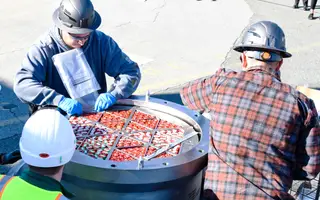
Idaho National Lab got the first batch of TRISO fuel for the Pentagon's Project Pele microreactor at its test site. BWXT gave the full core of fuel to the lab for tests as early as 2027.[1][2][3]
The Army gave $28.6M to City Light and Power Aberdeen LLC at Aberdeen Proving Ground for a microgrid and backup power.[1]
The Army started the Janus Program for new nuclear power with the Pentagon innovation unit at its own bases.[1]
The Department of the Navy gave $5. 7M to Serrano Construction and Development Corp.[1]
The Air Force gave Oklo its own power test at Eielson Air Force Base. They asked for 5 MW plus steam.[1]